Decoding Korea's Influence on Indian Markets


Last week over dinner, the conversation turned to what we’d been watching lately. My uncle, who’s in his fifties and has lived his entire life in Ahmedabad, said he had a recommendation. His usual recommendations revolve around Bollywood films.
“You should watch ‘Crash Landing on You’,” he said.
I nearly dropped my spoon.
Watching him describe a Korean drama with the same passion he reserves for Bollywood movies made something click: the Hallyu Wave (the rapid global popularity of South Korean culture since the late 1990s, spanning K-pop, dramas, film, food, fashion, and beauty) isn’t confined to college students anymore. It has reached dinner tables in Ahmedabad. And it’s not stopping at entertainment.
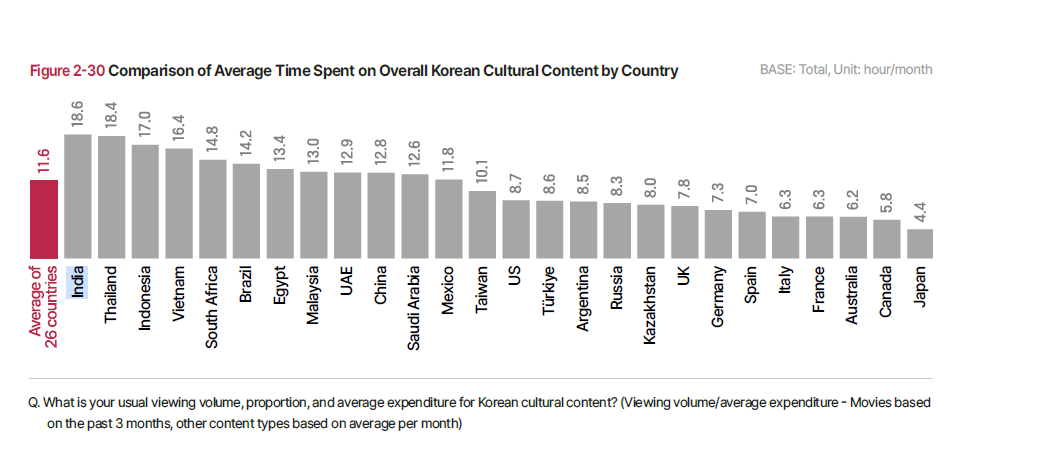
According to the South Korean government’s 2024 Overseas Hallyu Survey, Indians now consume 18.6 hours of Korean content per month. That’s the highest globally. But the real story isn’t happening just on Netflix. It’s also unfolding in wardrobes, where baggy Korean pants in soft pastels are finding a home. And it is also visible in kitchens, where Korean ramen has made its way onto grocery lists. It’s being witnessed in shopping carts, where multi-step Korean skincare routine products are replacing the legacy products.
This article traces how Korean culture is reshaping Indian consumer markets across categories. What follows is exploratory—documenting patterns we're observing rather than forecasting where they'll lead.
The Foundation: How K-Content Built a Market
When Squid Game racked up 19.6 million views in India, making it the country’s most-viewed international show, it wasn’t just urban English-speakers watching. Netflix data on anime consumption reveals that 80-90% of viewers prefer dubbed content over subtitles. Korean dramas became available in Hindi, Tamil, Telugu, Bengali, Marathi, Kannada, and Malayalam. That linguistic accessibility didn’t dilute the “Korean-ness” of the content. If anything, it amplified the reach.
This matters for brands because it reveals a principle that extends beyond content: Korean appeal isn’t language-dependent. It’s about aesthetics, innovation and quality standards.
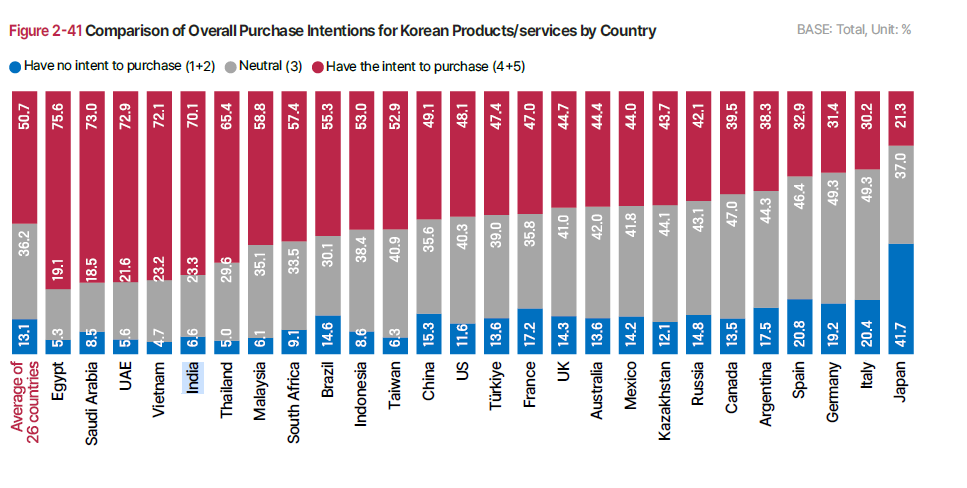
Increased exposure to K-content is driving a measurable shift in Indian consumer behaviour. As per the South Korean government’s 2024 Overseas Hallyu Survey, 70% of Indians with Hallyu experience indicated an intent to purchase Korean products.
The Food Frontier
Korean food’s entry into Indian kitchens was the first frontier crossed. It started, like everything else, with content. You watch characters in a K-drama eat kimchi fried rice or slurp tteokbokki, and suddenly you’re curious. Then you’re searching for where to order it. Then it’s in your regular rotation.
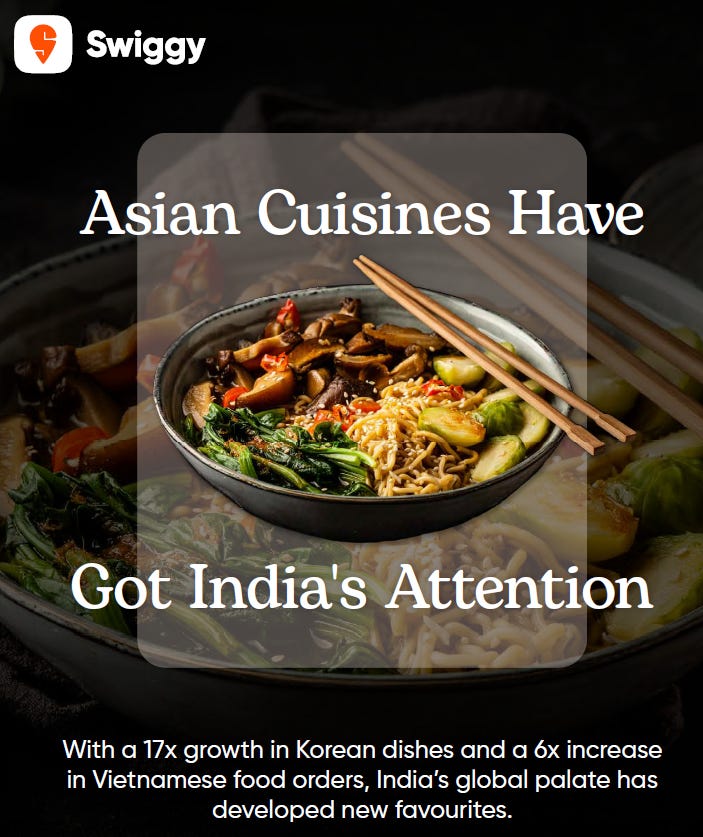
Swiggy reported a 17x growth in Korean dishes in 2025. Korean fried chicken, bibimbap, and Korean BBQ lead demand in metros like Bengaluru, Mumbai, and Hyderabad. But tier-2 cities like Surat, Thiruvananthapuram, Vadodara, Mysuru, and Mangaluru are growing even faster. Gen Z accounts for 27% of Korean food orders, but they’re bringing their families along.
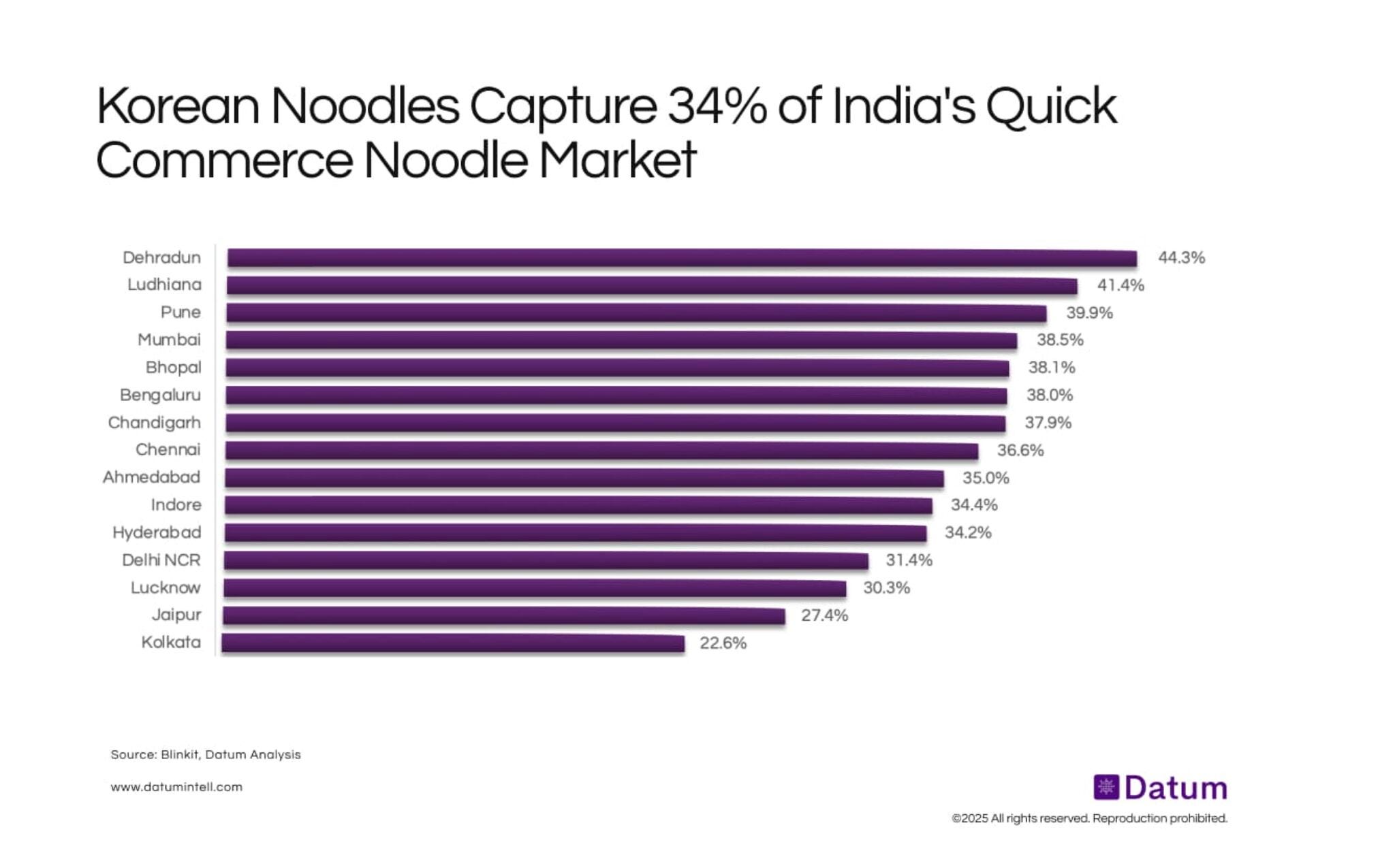
The instant noodle category tells an even more dramatic story. According to Blinkit and Datum Intelligence analysis, Korean noodles now account for 34% of noodle sales in top Indian cities on quick commerce platforms.
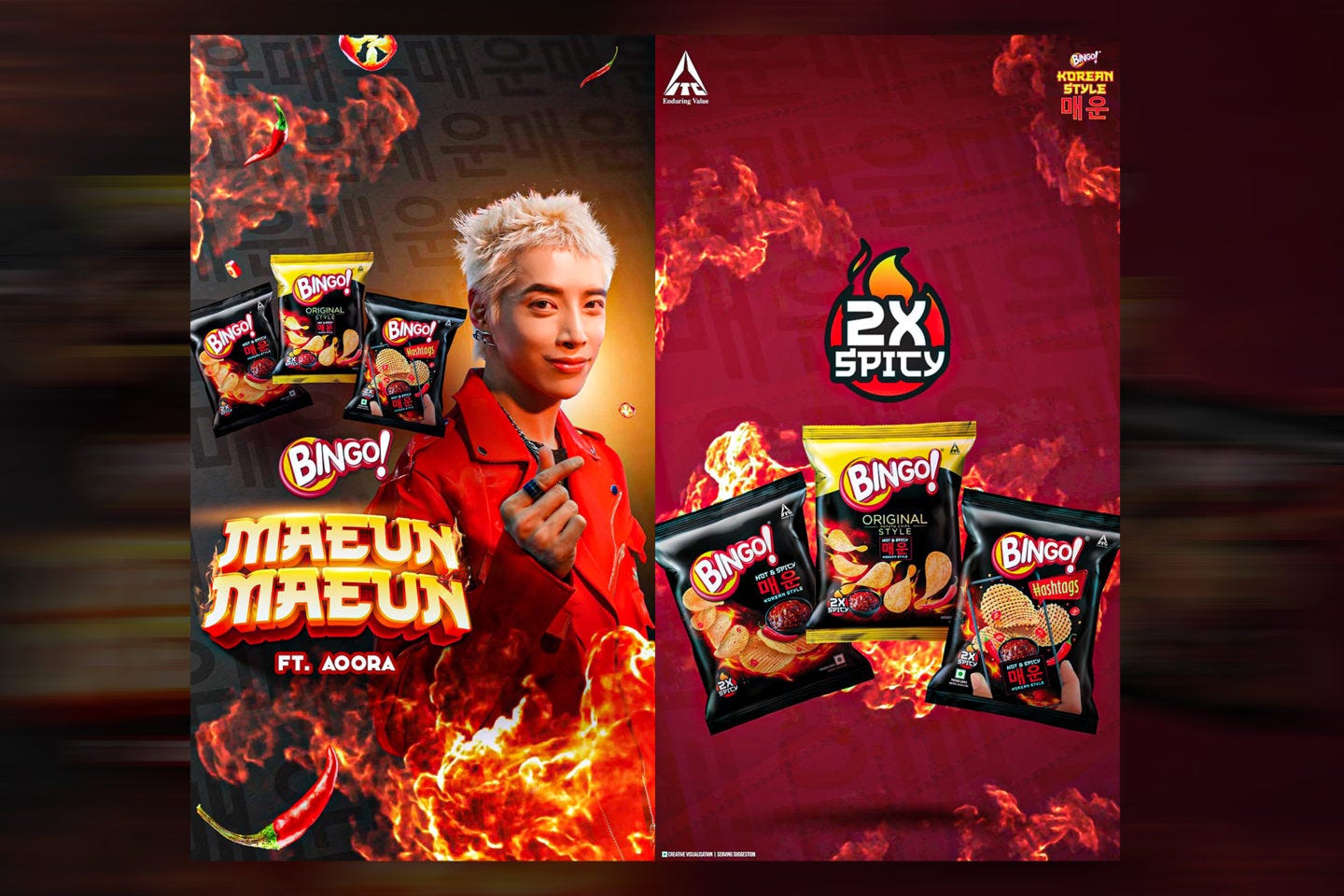
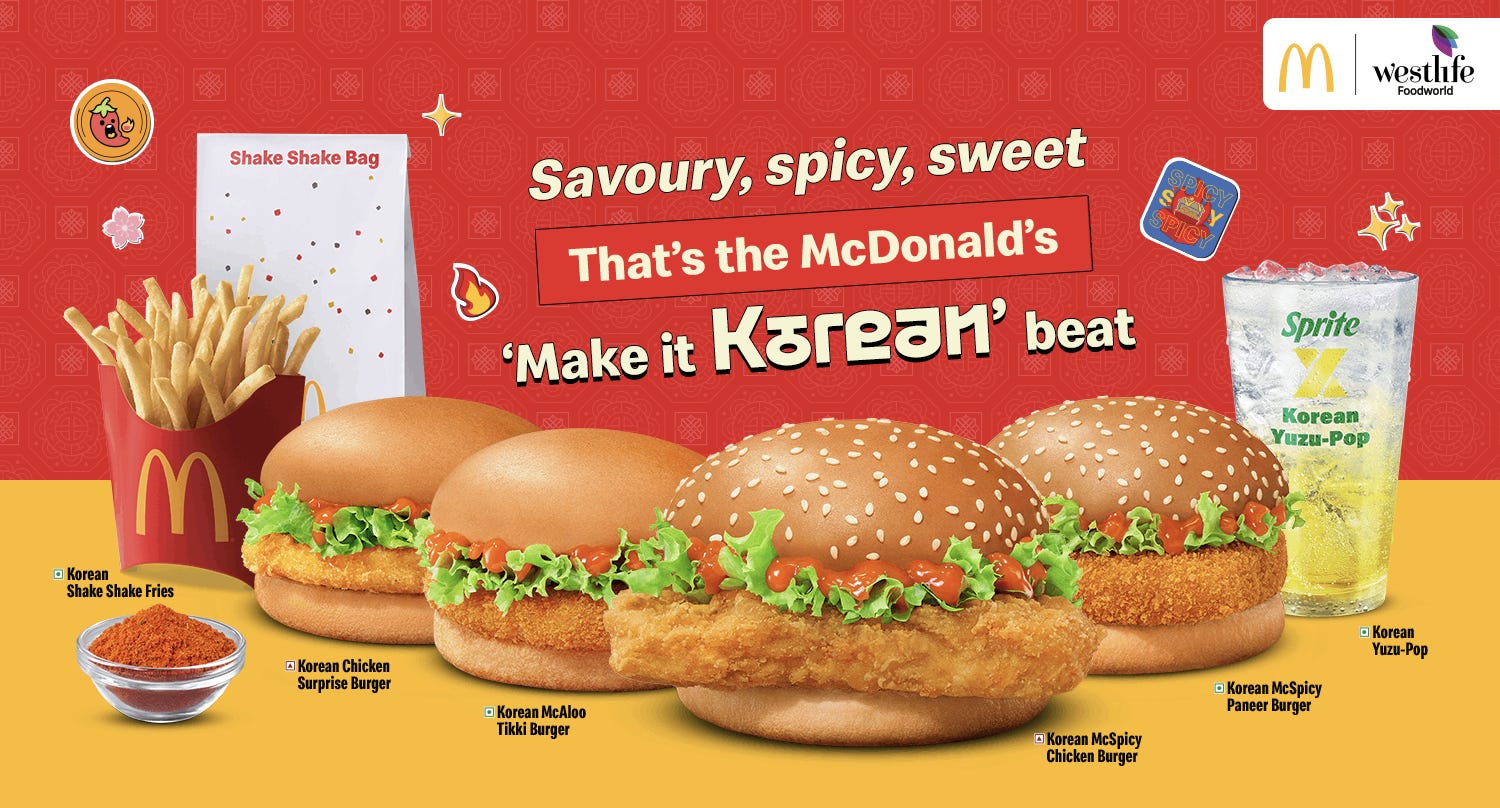
Brands like Samyang and Nongshim have grown rapidly. Indian companies noticed. Maggi launched a Korean noodle range. McDonald’s added Gochujang-spiced burgers. ITC collaborated with K-pop singer Aoora, to launch Korean-flavored chips.
India’s $1.5 Billion K-Beauty Opportunity
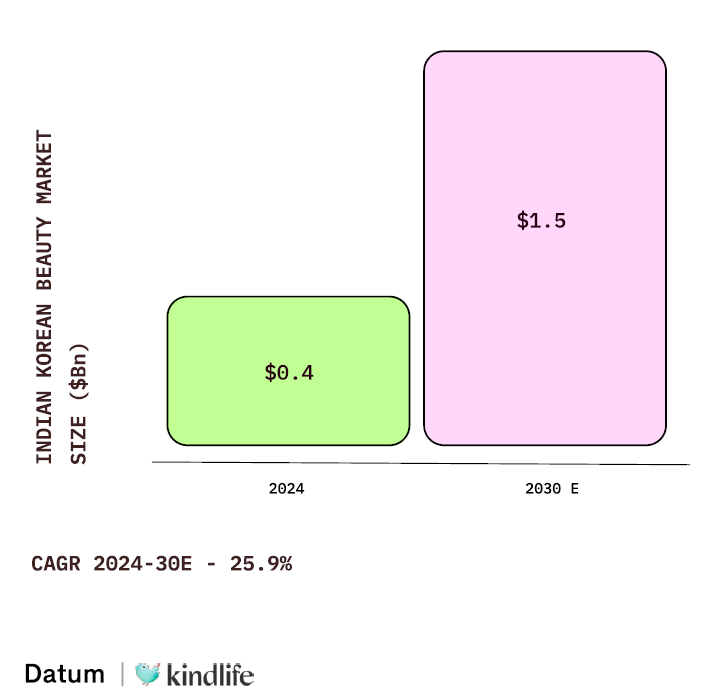
According to a joint study by Kindlife (marketplace for beauty products) and Datum Intelligence released in August 2025, the K-beauty market in India is projected to grow from USD 0.4 billion in 2024 to USD 1.5 billion by 2030. That’s a compound annual growth rate of 25.9%. Comparing that to the 11.7% CAGR expected for India’s overall beauty and personal care market, K-beauty is the fastest-growing segment in the category. The consumer base is set to more than double, from 11.9 million buyers in 2024 to 27.2 million by 2030.
Retailers are seeing this in real-time. In Nykaa’s Q2 FY2026 investor conference call, leadership stated that their Korean brand portfolio continues to grow at a very healthy rate of 60% year-on-year. To improve discovery, they launched a dedicated K-Beauty store within its app. Myntra reported similar momentum, with 80% year-on-year growth in K-beauty sales. What’s driving this growth is a close relationship between content consumption and commercial behaviour. According to the Kindlife-Datum Intelligence study, 50% of Indian consumers cite K-dramas or K-pop as the primary reason for trying K-beauty products.
Spending patterns show premiumization. Fifty-one percent of K-beauty buyers spend between ₹1,000 and ₹3,000 per month on products, according to the study. Eighty percent say they’re willing to pay a premium for quality. And here’s the experience economy signal: 80% express interest in workshops, pop-ups, and trial experiences. They want immersive engagement, not just transactions.
Indians want Korean skincare not just because it’s Korean, but because it represents something different, something that works. Ingredient efficacy is central to how Korean brands communicate with consumers. They build loyalty through science education rather than lifestyle aesthetics alone. The result is an industry that consistently originates global skincare trends. Conglomerates like AmorePacific and LG H&H allocate a significantly higher share of revenue to research than Western peers, operating dedicated biotech labs that validate ingredients clinically before commercialization. This rigorous approach gave rise to globally adopted actives like fermented ingredients such as galactomyces and bifida filtrate, Centella Asiatica, and ceramide complexes. Korea’s thriving OEM/ODM manufacturers like Cosmax and Kolmar further accelerate innovation by compressing development cycles to as little as three to six months.
Fashion, Tourism, and the Physical Proof of Soft Power
Fashion trends among the youth in India increasingly reflect Korean aesthetics: minimalist silhouettes, oversized streetwear, soft pastels and layering. Korean fashion Instagram accounts have become styling references.
Indian content creators are doing their own bit to build bridges with Korean culture. Sakshma Srivastav, with over 3 million YouTube subscribers and 334 million views, interviews K-pop groups and K-drama actors, often incorporating Hindi phrases to connect with Indian fans. Creators like her are cultural translators, making Korean content feel accessible while maintaining its distinctiveness.
Tourism data by Korea Tourism Organization shows that Indian arrivals to South Korea reached 176,668 visitors in 2024, representing 44% year-on-year growth. Thirty-two percent of young Indian travellers cite Hallyu (the Korean Wave) as a primary motivator for visiting. People are travelling, experiencing Korean culture and returning to India with suitcases full of Korean skincare, snacks, and fashion. And with stories that create more fans among their friends and family.
Case Study: Uni Seoul—Making Korean Aesthetics Accessible
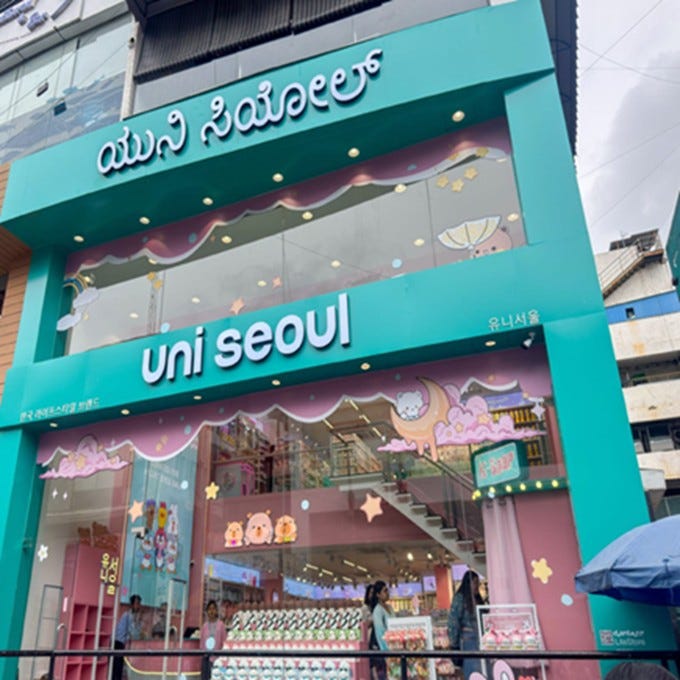
In April 2023, when Mohit Khurana and Gaurav Karmani launched Uni Seoul, they weren’t betting on a trend. They were reading a fundamental shift in Indian consumer preferences.
Uni Seoul is a Korean-inspired lifestyle brand that spans home and living, bags, plush toys, gifts, beauty and care, lifestyle items, travel accessories, and school essentials. Everything is priced between ₹99 and ₹2,999. The positioning is deliberate: elevate everyday products into unique experiences through cute aesthetic and functional design, but do it at price points accessible to India’s aspirational middle class, not just the luxury segment. It has tapped into broader Kawaii wave that has made “cute” a serious design language.
Uni Seoul recently inaugurated its 11th store. In such a short span of time, they have marked their presence in various cities like Bengaluru, Pune, Hyderabad, Nashik, Mumbai and Ahmedabad. Uni Seoul’s TG lies between the ages of 14-45 - Urban Gen Alpha, Gen Z, and millennials, plus family impulse shoppers who discover the brand during mall visits. This demographic has a deep affinity for K-Pop, K-Dramas and Korean lifestyle trends. The cute aesthetic, inviting store experience and affordable price point makes it the perfect blend for impulse buyers.
What This Means for Consumer Brands: Strategic Implications
If you’re building or marketing a consumer brand in India, the Korean Wave isn’t just an interesting cultural phenomenon. It’s revealing fundamental truths about the emerging Indian consumer.
For Indian brands, the opportunity isn’t copying Korean products. It’s understanding what Korean success stories reveal. When Maggi launches Korean noodle variants, when McDonald’s adds Gochujang burgers, when ITC partners with K-pop artists for chip flavours, they’re not betraying their brand identity. They’re adapting Korean innovation principles to their existing distribution muscle and brand trust.
The “Korean premium” is real, but quality is non-negotiable. Consumers spending 18.6 hours monthly consuming Korean content know the difference between genuine Korean inspiration and superficial Korean-washing. They’ve done the research. They’ve compared ingredients. They’ve watched the detailed reviews. If you’re going to leverage Korean association, it needs to be in your formulations, your design principles, your quality standards. Not just your packaging.
Geography matters more than most brands realize. The faster growth in Korean food orders from tier-2 cities isn’t an anomaly. It’s a pattern. Korean influence is spreading beyond metros. Even the local retailers in these cities are selling “Korean pants” now. Regional language content access has removed barriers, aspiration is high, and competition is lower. A Korean-inspired or Korean-imported brand establishing presence in Surat, Vadodara, or Mysuru today has first-mover advantages that might not exist in the coming three years.
There’s a white space opportunity hiding in plain sight: beauty tourism domestication. Indian beauty enthusiasts are flying to Seoul specifically for cosmetic procedures like AI-powered facials, multi-step Korean hair and scalp procedures, laser treatments, etc.
This demand is currently being exported because India doesn’t have supply. Korean beauty treatment centres combine technology-first diagnostics (AI skin analysis, scalp cameras), multi-step ritualistic treatments, and personalization at scale. India has clinical dermatology chains like Kaya (medical, not experiential), luxury hotel spas (generic, not Korean-specific), and traditional salons (transactional, no technology). Nobody occupies the Korean beauty treatment centre space.
With 11.9 million K-beauty buyers in India today growing to 27.2 million by 2030, already exhibiting ritual behaviour and premium willingness, there’s a customer base that would definitely try Korean beauty services domestically. The positioning writes itself: “Experience Seoul’s most advanced beauty treatments without the flight.” A possible opportunity there.
Beyond the Wave
When my uncle recommends Korean dramas over dinner, when Nykaa’s Korean portfolio grows 60% year-on-year, the numbers reflect that something about this country’s culture is aligning well with Indians.
India has millions of consumers who are globally curious but locally rooted. They watch K-dramas in Hindi and want Korean skincare adapted for Indian climate. They’re willing to pay premiums for innovation but they’re value-conscious. They’re digitally savvy but crave physical experiences. They’re routine-loyal but brand-fluid. They want credible detailed reviews and tutorials, not celebrity endorsements.
That consumer behaviour isn’t going away when K-drama trends eventually plateau. Korean influence simply revealed them. The Korean Wave didn’t create these preferences. It made them visible. The brands that win in the next decade won’t be asking “How do we sell Korean products?” They’ll be asking “What do Korean success stories teach us about the new Indian consumer?”
Because that consumer (educated, aspirational, digitally fluent, globally curious, locally rooted, quality-seeking) isn’t a temporary trend.
That’s just the new Indian consumer.
=========================================================================
 | A guest post by
|